
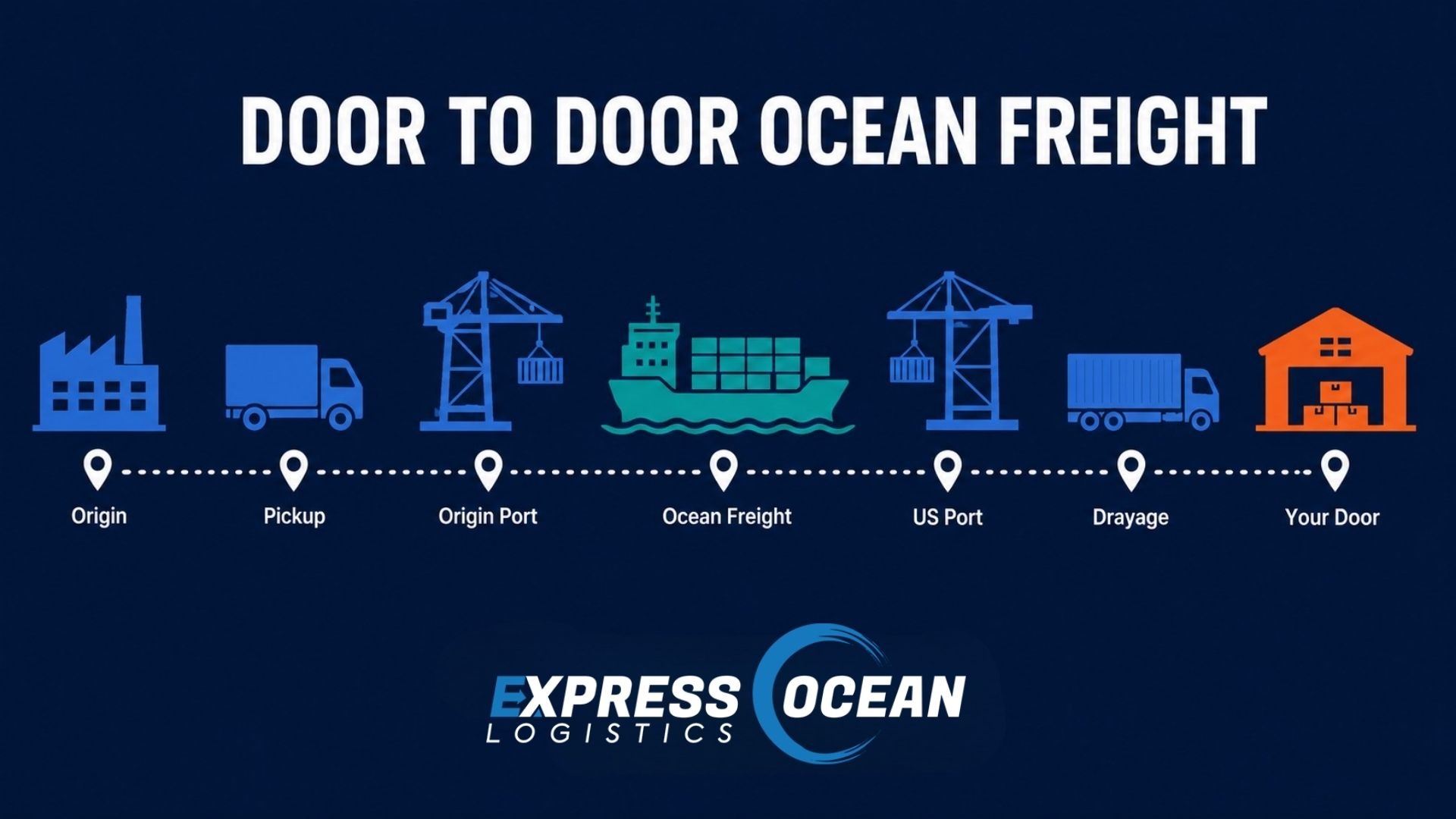
Door-to-door ocean freight is a shipping service where one freight forwarder manages the entire journey of your cargo, from pickup at the supplier's facility to delivery at your warehouse or final address. It includes origin collection, export customs clearance, ocean transit, US customs clearance, and final inland delivery under a single coordinated service. The importer deals with one provider and one point of accountability instead of arranging each leg of the shipment separately.
For a US business importing goods from overseas, the logistics chain has many moving parts: a trucker at the origin, an export customs agent, an ocean carrier, a US customs broker, a port, a drayage company, and a final delivery driver. Coordinating all of those separately is where delays, finger-pointing, and unexpected costs come from. Door-to-door ocean freight solves that by putting the entire chain under one provider.
This guide explains exactly what door-to-door ocean freight includes, how each stage of the journey works, how it differs from port-to-port shipping, and how Incoterms determine who is responsible for what. It is written from over 20 years of experience managing end-to-end shipments for US importers at Express Ocean Logistics.
What Door-to-Door Ocean Freight Actually Means
Door-to-door ocean freight, sometimes called end-to-end or origin-to-destination shipping, is a service model where a single freight forwarder takes responsibility for moving your cargo across every leg of its journey. The "doors" in the name are literal: the first door is your supplier's loading dock in the origin country, and the second door is your warehouse, distribution center, or delivery address in the United States.
The defining feature is not the ocean transit, which is common to every ocean freight service. The defining feature is the coordination of everything around the ocean transit: the inland transport at both ends, the customs clearance at both ends, and the documentation that ties it all together. When you book door-to-door, you are not buying a vessel slot. You are buying a managed outcome, where the cargo arrives at your door and the forwarder has handled every handoff in between.
This is the model most growing importers prefer because it removes the operational burden of stitching together multiple vendors. Rather than negotiating separately with a trucker in Shenzhen, a customs agent, an ocean carrier, a US broker, and a drayage company, you work with one international freight forwarder who manages all of them on your behalf and remains accountable for the whole chain.
What Door-to-Door Ocean Freight Includes
A complete door-to-door ocean freight service covers eight distinct stages. Understanding what sits inside the service helps you confirm scope with your forwarder and avoid assuming a step is included when it is not.
- Origin pickup (export haulage): Collection of the cargo from the supplier's factory or warehouse and transport to the origin port or consolidation point.
- Export customs clearance: Filing the export declaration in the origin country so the cargo is legally cleared to leave.
- Origin terminal handling: Receiving, documentation, and loading of the container onto the vessel at the origin port.
- Ocean transit: The sea voyage from the origin port to the US destination port on the carrier's vessel.
- ISF filing and US customs clearance: The Importer Security Filing before departure and the formal CBP entry on arrival so the cargo is released into US commerce.
- Destination terminal handling: Discharge of the container from the vessel and processing through the US port terminal.
- Inland drayage and delivery: Transport of the container from the US port to your final warehouse or address by truck.
- Coordination and documentation: The Bill of Lading, arrival notices, tracking updates, and the single point of contact that keeps every handoff connected.
How Door-to-Door Ocean Freight Works: The Full Journey
Here is how a typical door-to-door ocean freight shipment moves from the supplier's facility to the importer's warehouse, stage by stage.
The forwarder arranges a truck to collect the cargo from your supplier. For a full container, an empty container is positioned at the factory for loading. For smaller volumes, the cargo moves to a consolidation warehouse. This is the first door of the door-to-door journey.
The forwarder's origin agent files the export declaration with the origin country's customs authority. The cargo is cleared for export, and the forwarder confirms all documentation matches before the container is gated into the port terminal.
The container is received at the origin port, documented, and loaded onto the booked vessel. Before departure, the forwarder files the ISF with US Customs, which must be submitted at least 24 hours before the vessel sails to avoid penalties or holds.
The vessel carries your container across the ocean to the US destination port. This is the longest single stage, and the ocean freight transit time from Asia ranges from roughly two weeks to the West Coast up to five or six weeks to the East Coast, depending on the routing.
On arrival, the container is discharged and the forwarder's customs broker files the formal CBP entry. A clean entry clears in one to two business days, while errors in the paperwork are the main cause of customs delays that hold cargo at the port and eat into your free time.
Once CBP releases the cargo, a drayage truck collects the container from the terminal and delivers it to your warehouse or address. This final leg, the second door, completes the journey. Coordinating it within the port free time window is where reliable inland trucking matters most.
Door-to-Door vs Port-to-Port Ocean Freight
The most common point of confusion for importers is the difference between door-to-door and port-to-port service. The distinction is simply how much of the journey the forwarder manages.
| Journey Stage | Door-to-Door | Port-to-Port |
|---|---|---|
| Origin pickup from supplier | Included | Importer arranges |
| Export customs clearance | Included | Importer arranges |
| Origin terminal handling | Included | Included |
| Ocean transit | Included | Included |
| US customs clearance | Included | Importer arranges |
| Destination terminal handling | Included | Included |
| Inland delivery to your door | Included | Importer arranges |
| Single point of accountability | Yes | No, split across vendors |
Port-to-port covers only the middle of the journey, from the origin port terminal to the destination port terminal. Everything before and after is the importer's responsibility to organize. This can work for experienced importers who already have their own customs broker and drayage relationships, but it requires managing multiple vendors and accepting the coordination risk at every handoff.
Door-to-door, by contrast, makes one party responsible for the entire chain. If a problem arises at any stage, there is one provider to call and one provider accountable for the resolution. For most US importers, particularly those without an in-house logistics team, this single-accountability model is the practical advantage that makes door-to-door worth choosing.
How Incoterms Determine Door-to-Door Responsibility
Incoterms are the internationally recognized rules that define where the seller's responsibility ends and the buyer's begins in a cross-border shipment. They directly determine who arranges and pays for each leg of a door-to-door journey, so confirming the Incoterm before booking is essential.
In practice, most US importers buy under EXW or FOB and appoint a freight forwarder to manage the door-to-door journey themselves. This gives them control over the carrier selection, the customs broker, and the inland delivery, rather than relying on the seller's chosen providers. A door-to-door move built around a dedicated container follows the same operational sequence as standard FCL ocean freight, with the origin pickup and final delivery added at each end.
Why US Importers Choose Door-to-Door Ocean Freight
A single forwarder owns the entire chain. If anything needs attention at any stage, there is one team to contact and one party responsible for the outcome, rather than vendors pointing at each other.
When one provider coordinates every handoff, the gaps between stages shrink. Pre-filed customs, pre-scheduled drayage, and proactive tracking keep the whole journey on a reliable schedule.
One Bill of Lading, one set of customs filings managed in-house, and one arrival notice. The documentation that connects each leg is handled by the same team, reducing mismatches that cause holds.
Because one provider tracks the shipment across every stage, you get a single view of where your cargo is from origin pickup through final delivery, instead of stitching together updates from separate vendors.
You do not need relationships with a trucker, a customs agent, an ocean carrier, a broker, and a drayage company. The forwarder manages all of them, freeing your team to focus on your business.
Most supply chain delays happen at the handoff between two providers. Door-to-door eliminates most of those handoffs by keeping consecutive stages under one coordinated operation.
Door-to-Door for FCL and LCL Shipments
Door-to-door ocean freight is available for both full container and shared container shipments, and the journey is structured slightly differently for each.
For FCL door-to-door, a dedicated container is positioned at your supplier, loaded, sealed, and moves as a single unit all the way to your door. There is no consolidation or deconsolidation along the way, which keeps the timeline shorter and the handling minimal. This is the cleanest form of door-to-door because the same sealed container that leaves the supplier arrives at your warehouse.
For LCL door-to-door, your cargo is collected and taken to an origin consolidation warehouse where it is combined with other shipments to fill a container. At the destination, the container is deconsolidated and your portion is separated out for final delivery. This adds handling steps and time at both ends compared to FCL, but it makes door-to-door service accessible to importers whose volumes do not justify a full container.
What to Confirm Before You Book a Door-to-Door Shipment
Door-to-door service only works smoothly when the scope is clear from the start. Before you commit to a shipment, confirm these points with your forwarder so there are no surprises mid-journey.
Confirm exactly which stages are inside the quote. Origin pickup, both customs clearances, and final delivery should all be named explicitly. If duties, taxes, or insurance sit outside the freight scope, get that in writing. The quickest way to verify a forwarder runs a genuine end-to-end operation rather than subcontracting each leg is to ask whether they handle customs clearance in-house, because a forwarder that manages both the ocean leg and the entry filing closes the coordination gap where most delays start.
Confirm how the container moves once it lands. Ask how the drayage leg is scheduled relative to the vessel arrival. Picking the container up within the port free time window is what protects you from demurrage charges, so the forwarder should already have the inland delivery planned before the vessel berths, not after.
Confirm how you will see the shipment in transit. A real door-to-door service gives you visibility across every stage, not just the ocean leg. Real-time container tracking across the full journey, with proactive milestone updates, is the difference between knowing where your cargo is and chasing your forwarder for status.
Express Ocean Logistics runs all of this as one coordinated operation. The ocean transit, the customs entry, and the inland delivery are handled by the same team, so there is a single point of accountability from the supplier's dock to your warehouse. Importers moving a dedicated container can have the full journey built around their FCL ocean freight booking, with origin pickup and final delivery coordinated end to end.
Frequently Asked Questions About Door-to-Door Ocean Freight
These are the questions US importers ask most often about door-to-door ocean freight.
What is door-to-door ocean freight?
What does door-to-door ocean freight include?
What is the difference between door-to-door and port-to-port ocean freight?
Is door-to-door ocean freight available for both FCL and LCL?
How do Incoterms affect door-to-door ocean freight?
How long does door-to-door ocean freight take?
Ship Door-to-Door Without the Coordination Headaches
Express Ocean Logistics manages your entire ocean freight journey from origin pickup to final delivery, with customs and inland trucking handled in-house. Tell us about your shipment.
Get a Door-to-Door Quote