
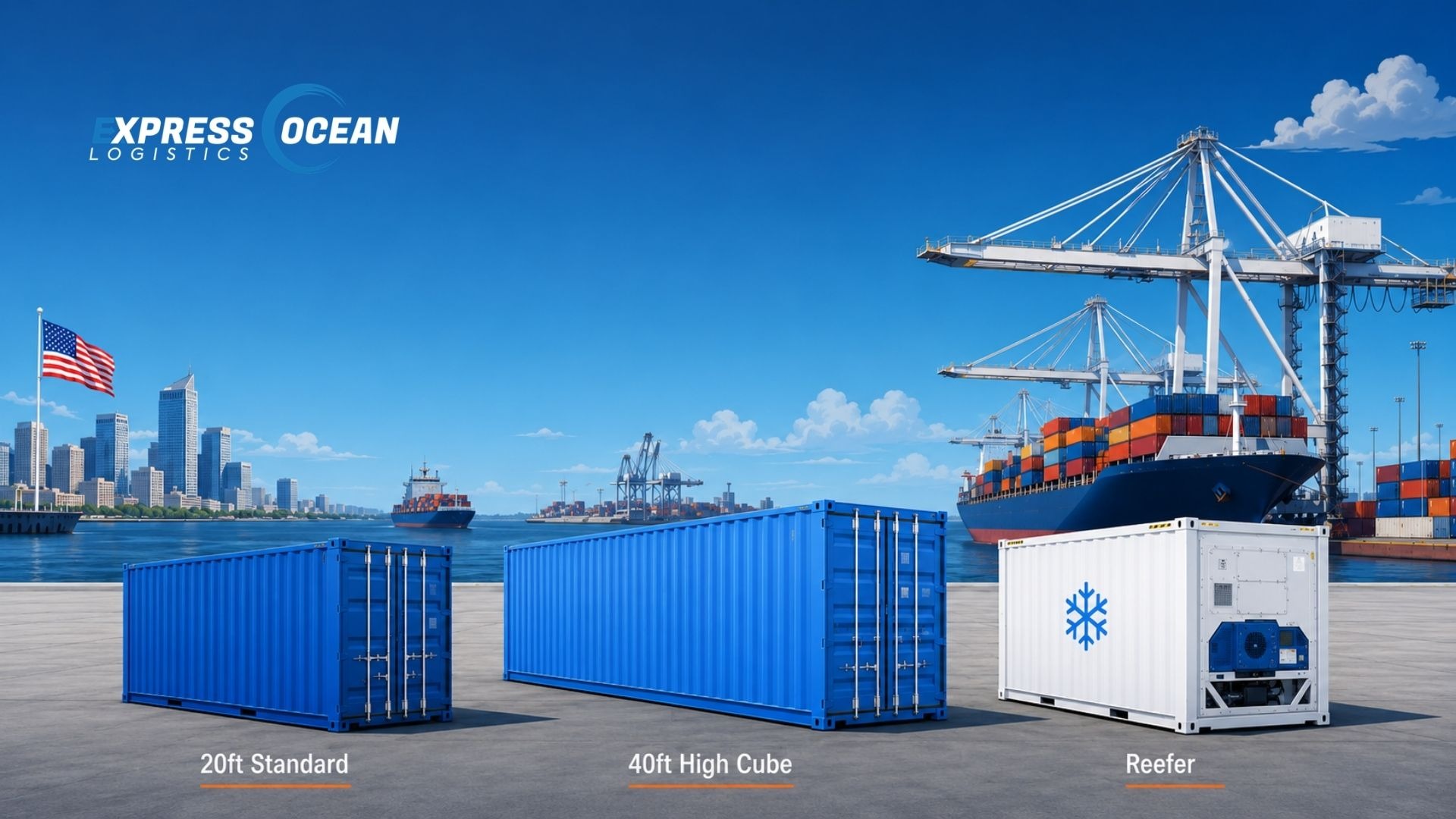
The three most common container types in ocean freight are the 20ft standard dry container, the 40ft standard or high cube dry container, and the reefer container. A 20ft container holds approximately 33 cubic meters and suits shipments of dense, heavy cargo up to around 25,000 kg. A 40ft container holds roughly 67 cubic meters and is the best choice for lighter, bulkier cargo or larger volumes. A reefer container is a refrigerated unit that maintains controlled temperatures for perishable cargo, pharmaceuticals, and temperature-sensitive goods. Choosing the right container type depends on your cargo volume, weight, dimensions, and whether it requires temperature control.
Picking the right container is one of the most practical decisions in ocean freight, and it is one that catches many importers off guard. The wrong choice adds cost, creates loading problems, or puts your cargo at risk. The right choice makes your shipment efficient, safe, and straightforward to clear through customs.
This guide covers every major container type used in commercial ocean freight, with exact specifications, ideal cargo types, and the practical factors that determine which container your shipment actually needs. The team at Express Ocean Logistics uses this knowledge on every shipment we handle, and we have condensed it here so you can make informed decisions before you book.
Why Container Selection Matters More Than Most Importers Realize
Container type affects more than just the space your cargo occupies. It determines whether your goods can be loaded safely, whether they will arrive in the same condition they left, and whether your shipment is compatible with the carrier's loading equipment and port handling procedures. An overloaded container can be rejected by the terminal or cause safety incidents at sea. A container that is too large for your cargo volume wastes money on unused space while still requiring you to pay for the full container.
For importers working with a freight forwarder, the container selection conversation happens early in the booking process. Your forwarder needs your cargo's weight, volume, dimensions, and any special handling requirements before they can advise on the right unit. If you are planning your first ocean freight shipment and want an overview of how the full process works from that initial booking through delivery, our guide on shipping by ocean freight for the first time covers every stage in order.
The 20ft Standard Dry Container
The 20ft standard dry container is the foundational unit of ocean freight. It is the basis for the TEU measurement used across the entire shipping industry. It works best for cargo that is dense and heavy relative to its volume, because it reaches its weight limit before its volume limit in most loading scenarios. Machinery, steel, automotive parts, tiles, and industrial equipment are all well-suited to the 20ft container.
Best for:
The 40ft Standard Dry Container
The 40ft standard dry container offers roughly double the volume of a 20ft unit at a freight rate that is significantly less than double, which makes it the most cost-efficient choice for most commercial import volumes. Note that the 40ft container has a slightly lower maximum payload than the 20ft, because its heavier tare weight (the weight of the empty container itself) consumes more of the gross weight limit set by the shipping line and port regulations.
Best for:
The 40ft High Cube Container
The 40ft high cube container is identical to the standard 40ft in footprint but adds approximately 30 centimeters of interior height, bringing the internal height from 2.39 meters to 2.69 meters. This adds around 8 to 9 cubic meters of usable volume. For cargo that is tall, bulky, or needs to be stacked higher than a standard container allows, the high cube is the practical choice. It has become the default container type on many trade lanes, with shipping lines now deploying high cubes as their standard 40ft unit.
Best for:
Reefer Containers: Temperature-Controlled Shipping
A reefer container is a thermally insulated shipping container with a built-in refrigeration unit powered by the vessel's electrical supply at sea and by shore power or a generator at port. The refrigeration system maintains a consistent set temperature throughout transit, and most modern reefer units log temperature data continuously so importers and their receivers can verify the cold chain was maintained from origin to destination.
Reefer containers have slightly less usable interior volume than their dry counterparts because the refrigeration equipment occupies space at one end of the unit. A 40ft reefer offers approximately 59 cubic meters of usable space compared to 67 cubic meters in a standard 40ft dry container.
Best for:
Other Container Types Worth Knowing
Beyond the three primary types, several specialist container configurations are relevant to importers handling cargo that does not fit standard dry containers.
An open top container has no fixed roof. Instead it uses a removable tarpaulin cover, allowing cargo that is too tall to fit through standard container doors to be loaded from above using a crane. The container itself is otherwise identical in footprint to a standard dry container, with the same door opening at one end.
Best for:
A flat rack container has only a floor and two collapsible end walls, with no side walls or roof. Cargo can be loaded from the sides or from above and can extend beyond the flat rack's dimensions, known as out-of-gauge cargo, subject to carrier approval. Flat racks are used for cargo that simply cannot fit inside any standard enclosed container.
Best for:
Full Comparison: All Container Types at a Glance
| Container Type | Int. Length | Int. Height | Volume (CBM) | Max Payload | Temp Control |
|---|---|---|---|---|---|
| 20ft Standard Dry | 5.90 m | 2.39 m | ~33 CBM | ~28,200 kg | No |
| 40ft Standard Dry | 12.03 m | 2.39 m | ~67 CBM | ~26,500 kg | No |
| 40ft High Cube | 12.03 m | 2.69 m | ~76 CBM | ~26,330 kg | No |
| 20ft Reefer | 5.44 m | 2.27 m | ~28 CBM | ~27,440 kg | Yes (-30 to +30C) |
| 40ft Reefer | 11.59 m | 2.27 m | ~59 CBM | ~29,460 kg | Yes (-30 to +30C) |
| 20ft Open Top | 5.90 m | No roof | ~32 CBM | ~28,130 kg | No |
| 40ft Flat Rack | 12.13 m | No walls | Platform only | ~40,000 kg | No |
How to Choose the Right Container for Your Shipment
The decision follows a clear sequence. Work through these steps before you confirm your booking with your freight forwarder.
Container availability also varies by trade lane and by season. On the transpacific route from China to the US, 40ft high cubes are the standard unit on most services, while 20ft containers are more common on routes originating from Southeast Asia and South Asia. Your freight forwarder should confirm what is available on your specific sailing. For a detailed breakdown of transit times on transpacific routes and how container type affects your delivery timeline, our guide on ocean freight transit times from China to the US covers every major route in detail.
Container Type and Documentation Requirements
Your container type affects the documentation your shipment requires. Standard dry container shipments follow the baseline US import documentation requirements: commercial invoice, packing list, Bill of Lading, and ISF filing at least 24 hours before vessel departure.
Reefer container shipments may require additional documentation depending on the commodity. Fresh produce, meat, dairy, and plant products typically require phytosanitary certificates, health certificates, or FDA Prior Notice, depending on the specific goods and their country of origin. Pharmaceutical reefer shipments often require GDP (Good Distribution Practice) documentation and temperature records from the manufacturer. Your customs broker should review the regulatory requirements for your specific reefer cargo before the booking is confirmed.
Open top and flat rack shipments carrying oversized or out-of-gauge cargo typically require a special stowage request from the carrier, which must be approved before booking. The carrier may also require a cargo securing plan confirming how the cargo will be lashed and braced on the container platform. Getting ahead of these requirements prevents last-minute delays at the origin port. Our team at Express Ocean Logistics manages all customs documentation and compliance requirements as part of our ocean freight services, so you have one point of contact covering both the freight and the paperwork.
Booking the Right Container Through Express Ocean Logistics
Once you know your container type, the next step is securing space on a vessel. Express Ocean Logistics books FCL container space directly with carriers across all major trade lanes, including transpacific, transatlantic, and Asia-to-US East Coast routes. Our FMC-licensed NVOCC status means we hold direct service contracts with carriers, which gives our clients access to consistent space allocations even during peak season when spot market capacity tightens.
For importers whose volumes do not yet justify a full container, we consolidate LCL cargo into our own FCL bookings. If you are still determining whether your shipment suits FCL or LCL, our guide on what a NVOCC does and why it matters explains how consolidation works and the protections that come with shipping through a licensed NVOCC.
Our digital platform gives every client real-time visibility on their container from origin pickup through port discharge and customs release. If you want to see how we manage container bookings, documentation, and tracking in one place, you can explore the platform's capabilities on our digital solutions page.
Frequently Asked Questions About Shipping Container Types
These are the container questions the Express Ocean Logistics team answers most often from importers planning their ocean freight shipments.
What is the difference between a 20ft and 40ft shipping container?
What is a reefer container and what cargo does it carry?
What is a high cube container and when do I need one?
How do I know which container size is right for my shipment?
What is a TEU and how does it relate to container sizes?
Can I mix cargo types inside one container?
Not Sure Which Container You Need?
Tell us your cargo details and the team at Express Ocean Logistics will confirm the right container type, check availability on your trade lane, and handle everything from booking to delivery.
Explore Our Ocean Freight Services