
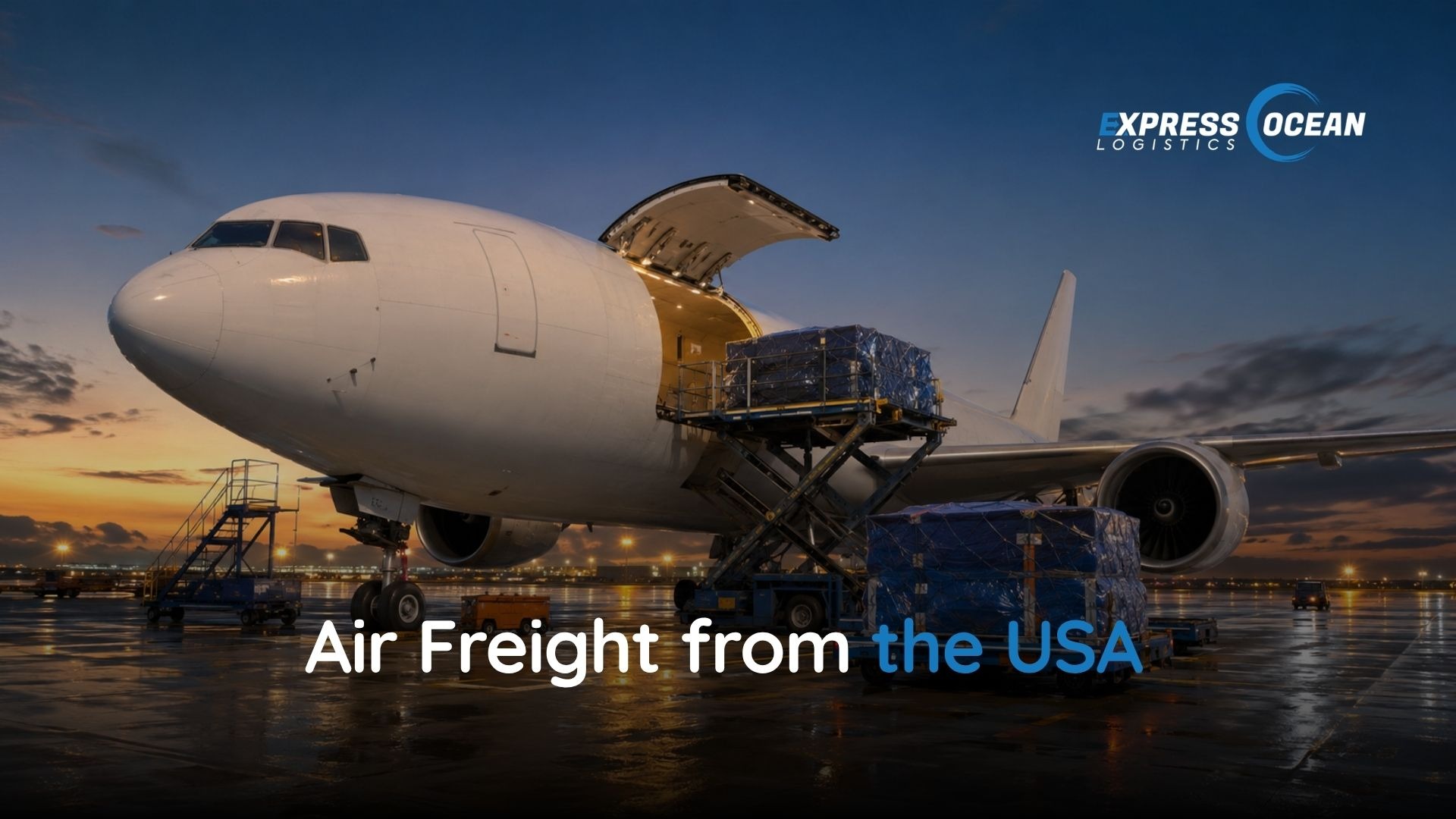
Air freight from the USA beats ocean when speed, reliability, or the nature of the cargo justifies the higher cost. It is the right choice for time-critical shipments, high-value goods, perishable cargo, urgent spare parts, and smaller shipments where the air premium stays manageable. Air moves cargo to Europe in 1 to 3 days and to Asia in 2 to 5 days, against several weeks by ocean. For large, heavy, low-value cargo without a deadline, ocean freight remains the more economical choice.
Every exporter and importer faces the same decision at some point: send it by sea and save money, or send it by air and save time. Most of the time ocean freight is the sensible default, which is why it carries the vast majority of world trade. But there are situations where the speed of air freight is not a luxury, it is the difference between meeting a commitment and losing it, and in those moments the extra cost is easily justified.
This guide explains exactly when air freight from the USA is the right call, how it compares with ocean on the things that matter, how air freight is priced, and when ocean still wins. The goal is to help you make the mode decision with confidence rather than defaulting to one out of habit. It is written from over 20 years of moving cargo by both sea and air at Express Ocean Logistics.
When Air Freight Beats Ocean
Speed is the obvious advantage of air, but the real question is when that speed is worth paying for. These are the situations where air freight consistently earns its premium.
When a shipment has to arrive by a fixed date, whether for a product launch, a contract deadline, or a retail window, air freight removes the weeks of ocean transit and the uncertainty that comes with it. Missing the deadline usually costs far more than the air premium.
For high-value cargo such as electronics, pharmaceuticals, or precision parts, the freight cost is a small share of the product value, so the air premium barely moves the landed cost. Air also spends less time in transit and in handling, which reduces exposure to loss and damage.
Food, flowers, pharmaceuticals, and other perishables have a shelf life that ocean transit cannot accommodate. Air freight gets them to market while they still have value, which is why entire supply chains for these goods are built around it.
When a production line is down or critical equipment has failed, the cost of waiting is enormous. Air freight delivers the part in days, so a small shipment by air prevents a large loss from downtime.
For a small or light shipment, the total air cost can be reasonable in absolute terms while delivering a major speed benefit. When the volume is low, the case for paying for air is much easier to make.
Air Freight vs Ocean Freight Compared
The two modes are not really competitors so much as tools for different jobs. Seeing them side by side makes the trade-off clear.
| Factor | Air Freight | Ocean Freight |
|---|---|---|
| Transit time | Days | Weeks |
| Cost per unit weight | Higher | Lower |
| Best cargo | Urgent, high-value, perishable, light | Heavy, bulky, low-value, non-urgent |
| Frequency | Daily flights on major lanes | Weekly sailings |
| Capacity | Limited by aircraft | Very large, full containers and more |
| Priced on | Chargeable weight | Container or volume |
| Transport document | Air waybill | Bill of lading |
The pattern is consistent. Air wins on speed, frequency, and handling exposure, while ocean wins on cost and capacity. This is exactly why many businesses use both, sending the bulk of their volume by ocean freight and reserving air for the shipments where speed is non-negotiable.
Air Freight Transit Times from the USA
Air freight transit is measured in days rather than weeks, though the exact time depends on the destination, the routing, and whether the service is express or standard. These are typical airport-to-airport ranges from the USA.
| Destination region | Typical air transit | Ocean, for comparison |
|---|---|---|
| Europe | 1 to 3 days | 2 to 3 weeks |
| Middle East | 2 to 4 days | 3 to 5 weeks |
| Asia | 2 to 5 days | 3 to 6 weeks |
| Latin America | 1 to 4 days | 1 to 3 weeks |
| Africa | 2 to 5 days | 4 to 6 weeks |
These are airport-to-airport figures. Door to door, air freight adds a little time for pickup, export clearance, customs at the destination, and final delivery, but it still lands far ahead of ocean. To put the contrast in perspective, a shipment that takes days by air can take the better part of a month by sea, which is the reality when you weigh air against ocean freight from China to the US on the busiest import lane.
How Air Freight Pricing Works
Air freight is priced differently from ocean, and understanding the basics helps you anticipate the cost and pack efficiently.
The key concept is chargeable weight. Air freight is charged on the greater of the shipment's actual gross weight and its volumetric weight, sometimes called dimensional weight. Volumetric weight converts the space the cargo takes up into a weight equivalent using a standard formula, so a light but bulky shipment is charged on the space it occupies rather than its actual weight. This is why packing efficiently matters so much in air freight: reducing wasted space in the packaging can directly reduce the chargeable weight.
Air Freight Documentation from the USA
The documentation for air freight is similar in purpose to ocean but uses different instruments. These are the core documents for an air freight export from the USA.
- Air waybill: The transport contract for the shipment and the air freight equivalent of a bill of lading, issued for the cargo moving by air.
- Commercial invoice: States the buyer, seller, goods, and value, and is the basis for customs at the destination.
- Packing list: Details the contents, weights, and dimensions, which also feed the chargeable weight calculation.
- Electronic Export Information via AES: Filed for shipments valued over 2,500 dollars per Schedule B code or requiring a license, the same US export requirement that applies to ocean.
- Dangerous goods declaration: For hazardous cargo, air freight requires IATA dangerous goods documentation and strict compliance, as air has tighter rules than ocean.
When Ocean Freight Is Still the Better Choice
Air is not always the answer, and a good freight partner will tell you when it is not. For a large share of cargo, ocean remains the smarter mode, and it is worth being honest about that.
If your cargo is heavy, bulky, or low in value relative to its weight, the air premium rarely makes sense, because you would be paying a large amount to move something that is not time-sensitive. If there is no hard deadline and the shipment can be planned in advance, ocean's lower cost wins comfortably. And for full container loads of general goods, ocean is built for exactly that job. The right approach is to match the mode to the shipment rather than committing to one for everything, and many importers run most of their volume by sea precisely because it is the more economical choice when time allows.
Air Freight from the USA with Express Ocean Logistics
Express Ocean Logistics moves cargo by both sea and air, so the mode decision is made on what serves your shipment best rather than on what we happen to offer. Our air freight service covers time-critical exports and imports from the major US gateways, with the documentation, the export filing, and the routing handled by one team.
Because we sit close to the Newark and New York air cargo gateways as well as the Port of New York and New Jersey, we can move a shipment by whichever mode fits, and switch a shipment to air when a deadline changes. Businesses across the country rely on us as an international freight forwarder in the USA precisely because they get one partner for both sea and air, with honest guidance on which one a given shipment actually needs.
Speed is a tool, not a default. Used in the right situations, air freight protects deadlines, revenue, and relationships that a delay would put at risk. The skill is knowing when that speed is worth paying for, and that is the judgment a good freight partner brings to every shipment.
Frequently Asked Questions About Air Freight from the USA
These are the questions shippers ask most often when deciding between air and ocean.
When should you use air freight instead of ocean?
How long does air freight from the USA take?
Is air freight more expensive than ocean freight?
What is chargeable weight in air freight?
What documents are needed for air freight from the USA?
What are the main air cargo airports in the USA?
Need It There Fast?
Express Ocean Logistics moves time-critical cargo by air from the major US gateways, with documentation and routing handled end to end. Tell us your deadline and we will find the fastest way.
Explore Our Air Freight Services